
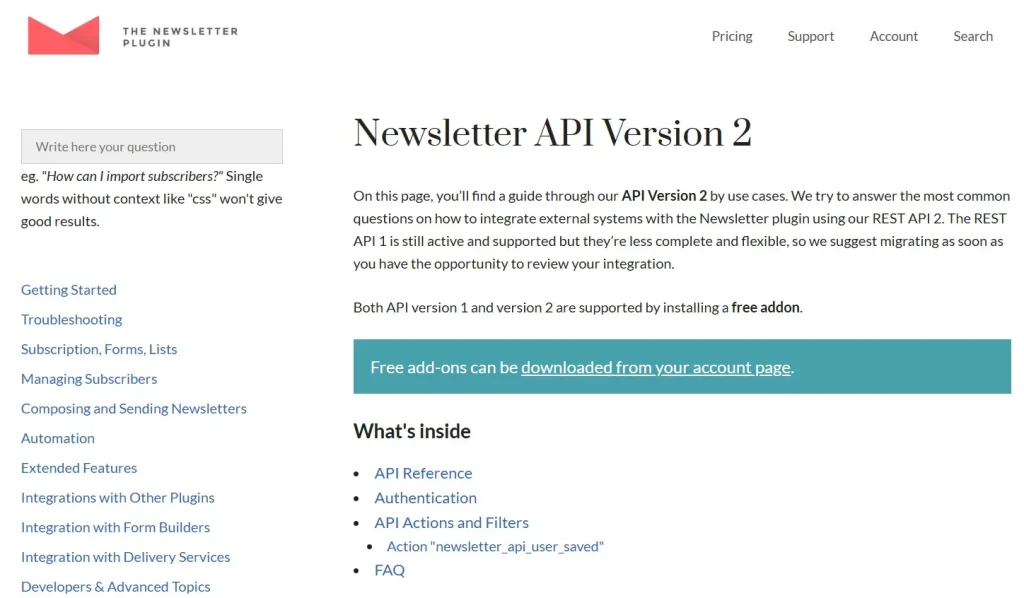
Newsletter – API v1 and v2 is a powerful extension designed to enhance the capabilities of the Newsletter Plugin by enabling seamless integration with external systems through structured API endpoints. From the first interaction, Newsletter – API v1 and v2 proves to be more than just a technical add-on—it is a critical bridge between WordPress-based email marketing and modern automation workflows.
As email marketing strategies become more data-driven, businesses increasingly rely on integrations between platforms such as CRMs, eCommerce systems, and third-party applications. Managing these connections manually is inefficient and prone to errors. Newsletter – API v1 and v2 solves this problem by providing a standardized way to send and retrieve subscriber data programmatically.
In practice, this means developers and marketers can automate processes such as subscriber registration, list synchronization, and campaign triggering. Instead of relying solely on manual imports or built-in forms, external systems can interact directly with the Newsletter plugin through API calls. This opens the door to advanced workflows that were previously difficult to implement.
Another key advantage lies in flexibility. By supporting both API v1 and v2, the plugin accommodates different technical requirements and legacy systems. This ensures compatibility across a wide range of use cases, from simple integrations to complex automation pipelines.
Over time, adopting an API-driven approach transforms how email marketing is managed. Teams can move from reactive processes to proactive automation, improving efficiency while maintaining full control over subscriber data.
In a real business environment, this transformation often leads to measurable improvements. For instance, marketing teams can reduce delays between user actions and email responses, which directly improves engagement rates. Instead of waiting for scheduled imports, subscribers are added instantly, allowing campaigns to respond in real time.
Another important perspective is operational scalability. As organizations grow, their tech stacks become more complex. Newsletter – API v1 and v2 provides a stable foundation that allows new tools to be integrated without disrupting existing workflows. This adaptability is essential for long-term system evolution.
What is Newsletter – API v1 and v2?
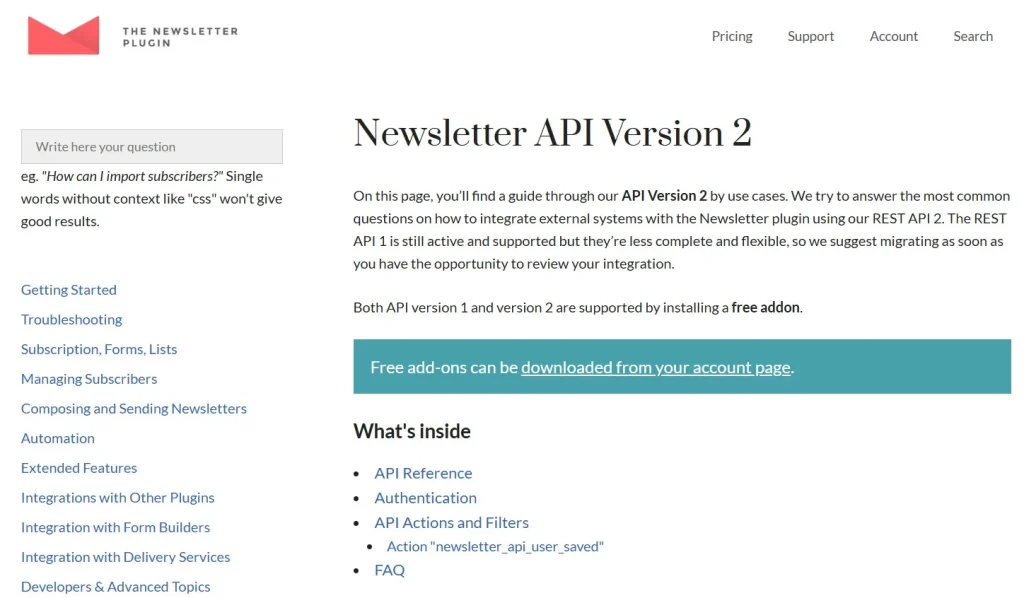
Newsletter – API v1 and v2 is an integration-focused extension for the Newsletter plugin that allows external applications to interact with subscriber data, mailing lists, and campaign workflows through API endpoints. It provides developers with the ability to send, retrieve, and manage data without relying on manual input.
At its core, the plugin acts as a communication layer between WordPress and other systems. API v1 typically offers a simpler structure, suitable for basic integrations, while API v2 introduces more advanced capabilities, improved security, and expanded functionality. This dual-version support ensures that both legacy and modern systems can work seamlessly with the plugin.
This makes Newsletter – API v1 and v2 particularly valuable for businesses that rely on multiple platforms. For example, an eCommerce store can automatically add customers to a mailing list after a purchase. Instead of exporting customer data manually, the store sends it directly to the Newsletter plugin via API.
Agencies and developers also benefit from this system when building custom solutions. A developer might create a custom signup form on a mobile app, then use the API to send subscriber data to WordPress. This ensures that all data remains centralized while still allowing flexibility in how it is collected.
In real-world applications, the plugin is often used as part of a larger automation ecosystem. Marketing teams can connect it with CRM systems, analytics tools, or third-party services to create seamless workflows. This reduces manual work and improves data accuracy.
Another important aspect is scalability. As subscriber lists grow, manual management becomes increasingly inefficient. Newsletter – API v1 and v2 enables automated data handling, making it easier to manage large volumes of subscribers without additional effort.
A deeper advantage appears when integrating cross-platform ecosystems. For example, a business running both a mobile app and a website can unify subscriber data into a single system. This eliminates fragmentation and ensures that all marketing efforts are based on consistent data.
Additionally, the plugin supports long-term system stability. By using structured API endpoints, developers can build integrations that remain functional even as internal systems evolve. This reduces the need for frequent redevelopment and lowers maintenance costs.
Key Features of Newsletter – API v1 and v2
- Dual API Version Support (v1 and v2)
The plugin supports both API v1 and v2, allowing users to choose the version that best fits their needs.
API v1 is typically used for simpler integrations, while API v2 offers enhanced functionality and better structure. This flexibility ensures compatibility with a wide range of systems.
In practice, businesses can maintain existing integrations using v1 while gradually transitioning to v2 for improved performance and features.
This staged transition is particularly useful in enterprise environments where system upgrades must be implemented carefully without disrupting ongoing operations.
- Subscriber Management via API
Newsletter – API v1 and v2 allows external systems to create, update, and delete subscribers programmatically.
For example, when a user signs up through a third-party form, their information can be sent directly to the Newsletter plugin without manual intervention.
This ensures that subscriber data remains consistent and up to date across all platforms.
In practice, this feature is often used in SaaS onboarding systems where user accounts are automatically linked to email campaigns.
- List and Segment Integration
The plugin enables API-based management of mailing lists and subscriber segments.
This is particularly useful for targeted marketing campaigns. For instance, an eCommerce platform can assign customers to specific segments based on purchase behavior.
In real-world scenarios, this allows marketers to create personalized campaigns without manual data sorting.
A deeper application includes behavioral segmentation, where users are dynamically assigned to lists based on real-time activity.
- Secure API Authentication
Security is a critical component of any API system. Newsletter – API v1 and v2 includes authentication mechanisms to ensure that only authorized systems can access data.
This protects sensitive subscriber information and prevents unauthorized access.
In practice, developers can configure API keys or tokens to control access, ensuring a secure integration environment.
This becomes especially important when handling large datasets or integrating with third-party platforms that require strict compliance standards.
- Real-Time Data Synchronization
The plugin supports real-time data exchange between systems.
For example, when a user updates their email preferences on an external platform, the changes can be reflected instantly in the Newsletter plugin.
This reduces data discrepancies and ensures that marketing campaigns are always based on accurate information.
In practice, this feature improves campaign timing, ensuring that users receive relevant messages without delay.
- Custom Integration Capabilities
Developers can use the API to build custom integrations tailored to specific business needs.
For instance, a SaaS platform can integrate its user database with the Newsletter plugin to automate onboarding emails.
This level of customization allows businesses to create unique workflows that align with their operations.
Advanced implementations often include connecting multiple systems into a unified automation pipeline.
- Campaign Triggering via API
The plugin allows external systems to trigger email campaigns programmatically.
A common use case is sending a welcome email immediately after a user registers on a website or app.
This automation improves response time and enhances user engagement.
Another example includes triggering follow-up emails based on user actions, such as completing a purchase or abandoning a cart.
- Scalable Data Handling
Newsletter – API v1 and v2 is designed to handle large volumes of data efficiently.
As subscriber lists grow, the plugin continues to perform reliably without requiring manual adjustments.
This makes it suitable for both small businesses and large-scale operations.
In high-traffic environments, this scalability ensures that data processing remains stable even during peak usage periods.
Benefits of Using Newsletter – API v1 and v2
Using Newsletter – API v1 and v2 provides clear operational advantages. One of the most significant benefits is automation. By enabling systems to communicate directly, the plugin reduces the need for manual data entry and repetitive tasks.
Another important benefit is accuracy. Automated data synchronization minimizes errors that often occur with manual processes. This ensures that subscriber information remains consistent across all platforms.
From a workflow perspective, the plugin improves efficiency. Teams can focus on strategy and content rather than managing data transfers. This leads to faster execution of marketing campaigns.
Scalability is also a key advantage. As businesses grow, their data management needs become more complex. Newsletter – API v1 and v2 provides a system that can handle increased demand without compromising performance.
In real-world applications, companies often see improved campaign performance due to better data accuracy and timely communication. This translates into higher engagement rates and better ROI.
Another benefit is flexibility in system architecture. Businesses are not limited to a single platform and can integrate multiple tools into their workflow.
Additionally, it supports better data-driven decision-making. With consistent and real-time data flow, marketing teams can analyze subscriber behavior more effectively and adjust strategies accordingly.
It also reduces operational bottlenecks. Tasks that previously required manual coordination between teams can now be automated, allowing organizations to scale faster without increasing workload.
Real Use Cases of Newsletter – API v1 and v2
Newsletter – API v1 and v2 is used in various practical scenarios. For eCommerce websites, it enables automatic subscription of customers after checkout, ensuring that marketing lists grow consistently.
Agencies use the plugin to connect client websites with external CRM systems. This allows them to manage subscriber data centrally while maintaining flexibility in campaign execution.
Developers often use the API to build custom signup forms or integrate mobile applications. For example, a mobile app can collect user emails and send them directly to the Newsletter plugin.
Content platforms benefit from real-time synchronization. When users subscribe to newsletters through different channels, all data is consolidated in one place.
Another common use case is event registration systems. Attendees can be automatically added to mailing lists, allowing organizers to send updates and follow-up emails efficiently.
A more advanced use case involves subscription-based platforms. Users can be automatically segmented based on subscription tiers, allowing for targeted communication strategies.
Additionally, digital product platforms can trigger email sequences based on user activity, such as downloads or course completions, creating a more personalized experience.
How to Install Newsletter – API v1 and v2
Installing Newsletter – API v1 and v2 follows a straightforward process within WordPress.
First, download the plugin file from a trusted source such as Pluginpro.org. Ensure that the base Newsletter plugin is already installed and activated, as this extension depends on it.
Next, log in to your WordPress dashboard and navigate to the Plugins section. Click “Add New,” then select “Upload Plugin.” Upload the ZIP file and click “Install Now.”
Once installation is complete, activate the plugin. The API functionality will then be available within the Newsletter plugin settings.
After activation, configure API settings such as authentication keys and endpoint access. This step is critical for ensuring secure communication between systems.
It is recommended to test the API using tools like Postman or similar platforms. Send sample requests to verify that data is being transmitted correctly.
In professional workflows, developers often document API usage and create standardized integration processes. This ensures consistency and simplifies future updates.
Another important step is setting rate limits and monitoring usage. This helps maintain system performance and prevents overload during high traffic periods.
Additionally, integrating logging systems can help track API activity. This provides valuable insights for debugging and optimizing workflows.
Why Buy Newsletter – API v1 and v2 at Pluginpro.org
Purchasing Newsletter – API v1 and v2 through Pluginpro.org offers substantial advantages, especially for developers, agencies, and businesses managing multiple integrations. One of the most compelling reasons is cost efficiency. Instead of purchasing individual licenses for each project, users can access the plugin at a significantly reduced price.
In real-world scenarios, this becomes highly valuable when managing multiple client websites. For example, an agency integrating email systems for several clients can deploy Newsletter – API v1 and v2 across all projects without increasing licensing costs. This allows for predictable budgeting and improved profit margins.
Another important advantage is unlimited usage. Pluginpro.org enables users to install the plugin on multiple websites without restrictions. This flexibility is essential for developers who build custom solutions across different environments. Instead of tracking licenses for each domain, they can focus on delivering functional integrations.
Security and reliability are also key considerations. Pluginpro.org provides clean plugin files that are safe to use. This ensures that API connections remain stable and free from hidden issues. In practice, stable integrations are critical because even small disruptions can affect automated workflows and data synchronization.
Ease of updates further strengthens the value proposition. Managing API-based systems often requires regular updates to maintain compatibility with external platforms. Pluginpro.org simplifies this process by offering centralized access to updated versions, reducing maintenance overhead.
Another practical benefit appears in rapid deployment scenarios. When a new integration project begins, having immediate access to the plugin allows developers to start building API connections without delay. This shortens development timelines and improves project delivery speed.
From a long-term perspective, the cost savings accumulate significantly. Businesses that continuously develop integrations can reinvest saved resources into scaling their infrastructure or improving marketing strategies. This makes Pluginpro.org not just a cost-saving option but a strategic asset for growth.
Additionally, agencies can standardize their development stack using Pluginpro.org resources. This reduces variability between projects and allows teams to work more efficiently with familiar tools.
Another scenario involves scaling SaaS platforms. As user bases grow, the ability to deploy integrations without additional licensing constraints becomes a major operational advantage, enabling faster expansion without increasing costs.
Is Newsletter – API v1 and v2 Worth It?
Yes, Newsletter – API v1 and v2 is worth it for anyone who needs to integrate WordPress email marketing with external systems efficiently and reliably.
It is particularly valuable for developers, agencies, and businesses that rely on automation. For example, an eCommerce platform that wants to synchronize customer data with email campaigns can use the API to eliminate manual processes entirely.
Another practical scenario involves SaaS platforms that collect user data outside of WordPress. By connecting their systems through the API, they can centralize subscriber management while maintaining flexibility in data collection methods.
The plugin is also worth considering for growing businesses. As subscriber lists expand, manual management becomes unsustainable. Newsletter – API v1 and v2 provides a scalable solution that supports long-term growth.
Additionally, teams working with complex workflows benefit from the ability to trigger campaigns, update lists, and manage subscribers programmatically. This level of control is difficult to achieve with standard tools alone.
It is also highly valuable for businesses focused on personalization. By integrating behavioral data into email workflows, companies can deliver more relevant content to subscribers.
For organizations aiming to build advanced marketing automation systems, this plugin provides the infrastructure needed to connect multiple tools into a cohesive ecosystem.
Conclusion
Newsletter – API v1 and v2 transforms how WordPress-based email marketing systems interact with external platforms. By providing structured API access, it enables automation, improves data accuracy, and supports scalable workflows.
For developers and marketers, this means greater control over how subscriber data is managed and utilized. Instead of relying on manual processes, they can build efficient systems that operate in real time.
Over time, the impact becomes even more significant. Automated workflows reduce operational overhead, while improved data synchronization enhances campaign effectiveness.
Another important takeaway is long-term adaptability. As technology stacks evolve, having a flexible API system ensures that integrations remain functional and relevant.
For anyone looking to modernize their email marketing infrastructure, Newsletter – API v1 and v2 offers a reliable and flexible solution that aligns with current digital practices and future growth needs.