
Choosing the right SEO plugin is one of the first decisions WordPress users make after launching a website. Since both plugins promise better search visibility, XML sitemaps, schema markup, and on-page optimization, the Yoast SEO vs Rank Math debate remains one of the most common questions among bloggers, businesses, and agencies.
While both plugins cover the core SEO essentials, they take different approaches to content optimisation, technical SEO, and overall workflow.
This guide compares Yoast SEO and Rank Math based on ease of use, content optimisation, technical SEO, schema support, and overall value. It will help you understand where each plugin performs best and which one is more suitable for your WordPress website.
1. Key Differences Between Yoast SEO and Rank Math
If you only need a quick overview before exploring the details, the table below highlights the biggest differences.
| Feature | Yoast SEO | Rank Math |
| Free version | Covers essential SEO tools | Includes many advanced SEO features |
| User interface | Simple and beginner-friendly | Modern dashboard with modular settings |
| Focus keywords | One keyword in free version | Multiple keywords in free version |
| Schema support | Common schema types | Larger schema library and custom schema |
| WooCommerce SEO | Premium add-on | Many WooCommerce options included |
| AI features | AI writing assistance (Premium features) | AI content tools available separately |
| Pricing model | Premium features sold individually | More features bundled into Pro plans |
This table gives you a quick snapshot, but the real differences become clearer once you understand why each plugin was built the way it is which we’ll break down next.
2. Overview of Yoast SEO and Rank Math
2.1. Yoast SEO: A Decade-Long Standard
Yoast SEO has been around since 2010 and has grown into one of the most recognised names in WordPress SEO. It was built on a simple idea: SEO shouldn’t require technical expertise. Instead, guided suggestions and visual feedback do most of the work for you.

This philosophy shows up clearly in its long-running traffic-light system, which turns complex ranking factors into a few clear, actionable checks. It’s this approach more than any single feature that has kept Yoast SEO popular among bloggers and small business owners for over a decade.
2.2. Rank Math: The Feature-Packed Challenger
Rank Math entered the market years after Yoast SEO with a different strategy: pack more advanced tools directly into the free version instead of charging for separate add-ons. This approach quickly attracted users seeking more functionality without additional cost.
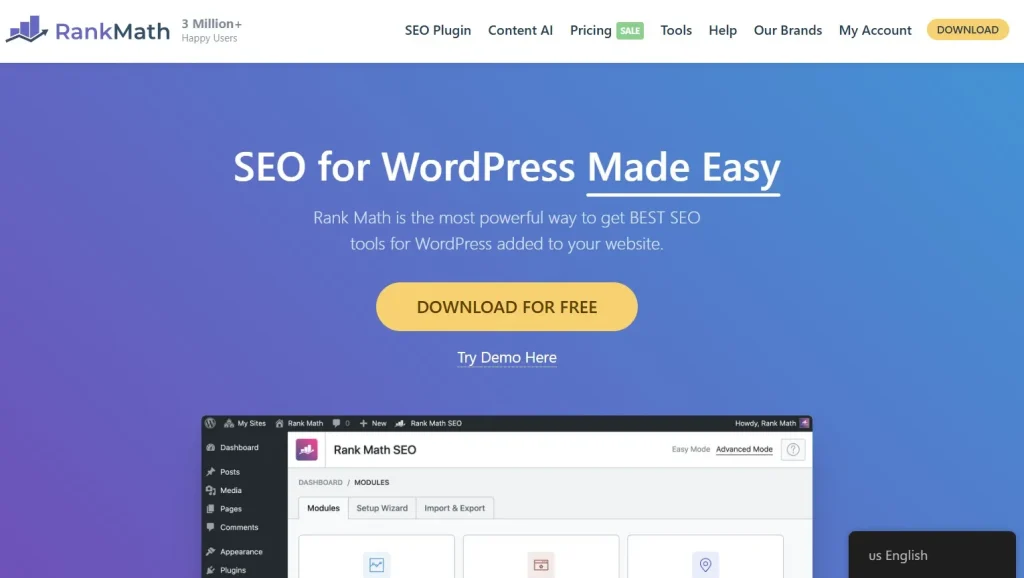
Rather than following Yoast SEO’s simplified, guided approach, Rank Math was designed with power users in mind. Its modular settings let you turn features on or off depending on how deep you want to go with SEO configuration. This structure appeals especially to agencies and experienced site owners.
3. Yoast SEO vs Rank Math: Feature-by-Feature Comparison
3.1 Ease of Use: Dashboard and Setup
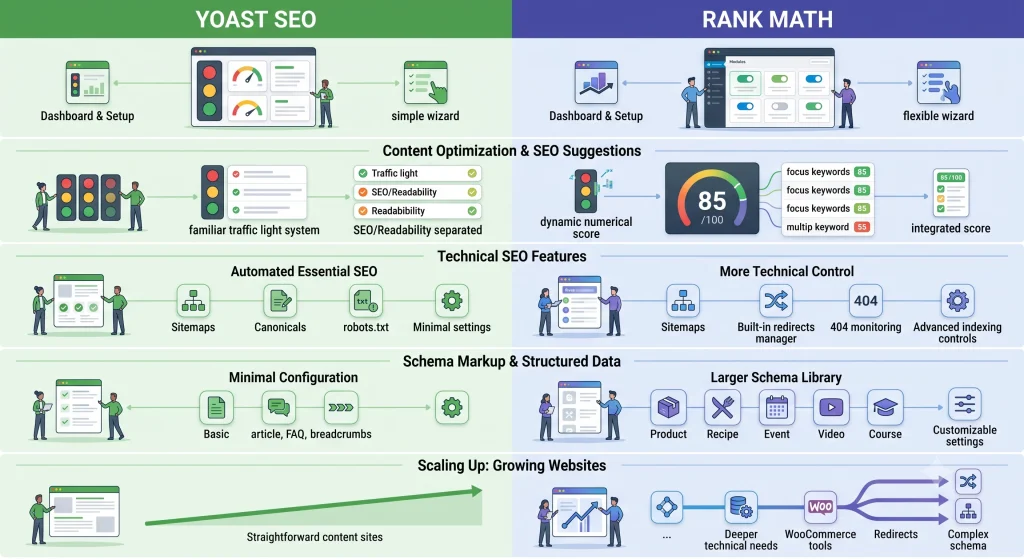
The first difference most users notice is the dashboard. While both plugins offer setup wizards, they take very different approaches to organizing SEO settings.
Yoast SEO keeps its interface clean and limits the number of visible settings. New users can optimize content without needing to learn technical SEO terminology. The plugin also explains many recommendations in plain language, making it approachable for bloggers and small business owners.
Rank Math displays more options from the beginning. Although the setup wizard simplifies configuration, users still need to configure additional modules, scoring systems, and SEO settings. Experienced WordPress users may appreciate that extra control, but complete beginners could need more time to become familiar with the interface.
In short, Yoast SEO trades some flexibility for a simpler starting point, while Rank Math trades that simplicity for more built-in control.
3.2 Content optimisation and SEO Suggestions
Both plugins help optimize content before publication, but the way they deliver SEO recommendations differs significantly.
Yoast SEO separates SEO analysis from readability analysis. It checks title length, meta descriptions, internal links, headings, transition words, passive voice, and keyword placement using its familiar colour indicators.
Rank Math combines these suggestions into a numerical SEO score and allows several focus keywords in its free version. Users can optimize related search terms without upgrading immediately.
If you prefer simple, easy-to-follow recommendations, Yoast SEO is easier to work with. If you want to optimize for multiple keywords and see an overall SEO score, Rank Math offers more flexibility.
3.3 Technical SEO Features Compared
Both plugins automate most technical SEO tasks, so you don’t need to configure everything manually after installation.
Yoast SEO automatically handles XML sitemaps, canonical URLs, robots metadata, breadcrumbs, and indexation settings with minimal configuration. Rank Math includes the same core technical SEO features while adding built-in redirect management, 404 monitoring, role management, and more detailed indexing controls.
For most websites, both plugins cover the essential technical SEO tasks. The biggest difference is that Rank Math gives users more control over advanced settings without relying on additional extensions.
3.4 Schema Markup and Structured Data Control
Both plugins automatically generate schema markup, but they differ in how much control they give you over structured data.
Yoast SEO focuses on adding schema that matches the page type with minimal configuration. Posts, pages, articles, FAQs, and breadcrumbs automatically receive structured data, allowing most users to leave the default settings unchanged. This reduces the chance of incorrect schema implementation.
Rank Math gives users more direct control. It includes a larger collection of schema templates, such as Product, Recipe, Event, Course, Job Posting, and Video. You can also customize schema properties or save templates for repeated use across similar content.
Standard blogs and business websites rarely need to adjust schema settings manually, so Yoast SEO’s automatic setup works well in most cases. However, once a site starts publishing recipes, products, or events, Rank Math’s wider schema library becomes noticeably more useful.
3.5 Scaling Up: SEO for Growing Websites
As a website grows, SEO requirements often become more complex. You may need to manage redirects, optimize several content types, control schema markup, or handle SEO settings across multiple websites.
Yoast SEO remains a practical choice for websites that prefer a simple and predictable workflow. Its core tools cover the needs of most blogs, business websites, and content-focused projects without requiring extensive configuration.
Rank Math is better suited to users who expect to use more advanced features over time. Its broader technical controls, schema options, WooCommerce tools, and modular features make it easier to manage more complex websites from one dashboard.
In short, Yoast SEO scales well for straightforward content sites, while Rank Math scales better for websites with more moving parts, additional content types, more redirects, or deeper schema needs across many pages.
4. Who Should Choose Each One?
4.1 Yoast SEO Fits Bloggers and Beginners
Bloggers, small business owners, and WordPress beginners often find Yoast SEO to be the more comfortable starting point. Its readability checks and streamlined publishing flow keep the focus on content, without adding technical complexity. It is especially suitable for content-focused websites where readability guidance and a straightforward publishing workflow are more important than advanced customization.
4.2 Rank Math Fits WooCommerce Stores and Agencies
WooCommerce store owners, agencies, and developers managing multiple sites tend to lean toward Rank Math. Its deeper control over schema, redirects, and indexing suits teams handling more complex SEO workflows. It is also a practical option for users managing several websites or optimizing content for multiple keywords.
5. Other Tools That Support WordPress SEO
Yoast SEO and Rank Math can handle metadata, XML sitemaps, schema markup, and many technical SEO settings. However, neither plugin can improve every factor that affects search performance. Website speed, image optimisation, page structure, and reliable backups also play an important role in maintaining a healthy WordPress website.
The following tools can complement either SEO plugin and help you build a faster, more stable, and better-optimized website.
5.1. WP Rocket
Website speed can affect user experience, Core Web Vitals, and how easily visitors interact with your content. WP Rocket improves WordPress performance through page caching, file optimisation, lazy loading, and database cleanup.
It works alongside both Yoast SEO and Rank Math without replacing their SEO features. This makes WP Rocket a useful addition for website owners who want to improve loading times while keeping their existing SEO setup.

5.2. Imagify
Large image files can slow down blog posts, landing pages, and WooCommerce product pages. Imagify automatically compresses and converts images into lighter formats, helping reduce page size without requiring manual editing.
Using Imagify alongside Yoast SEO or Rank Math allows you to optimize both the content and performance sides of your website. This is especially useful for image-heavy blogs, portfolios, and online stores.
5.3. Elementor Pro
Elementor Pro gives users greater control over page layouts, landing pages, headers, templates, and WooCommerce designs. Both Yoast SEO and Rank Math can be used with Elementor, allowing you to edit SEO titles, meta descriptions, and other optimization settings as you work on your pages.
This combination is helpful for users who want to create visually customised pages without separating their design and SEO workflows.
5.4. UpdraftPlus
Before switching SEO plugins, changing indexing settings, or installing major updates, always create a full website backup. UpdraftPlus can back up WordPress files and databases, making it easier to restore the website if an update or configuration change causes problems.
It does not directly improve rankings, but it protects your SEO work by reducing the risk of losing settings, content, redirects, or website data.
5.5. Yoast SEO Premium
If you decide that Yoast SEO is the right fit for your website, Yoast SEO Premium unlocks additional tools, including redirect management, internal linking suggestions, and related keyphrase optimization.
PluginPro provides access to Yoast SEO Premium, along with WP Rocket, Imagify, Elementor Pro, UpdraftPlus, and many other premium WordPress tools, making it easier to build and maintain a complete WordPress website from one place.
6. Frequently Asked Questions
6.1. Is Yoast SEO or Rank Math better for beginners?
Yoast SEO is generally easier for beginners because it has a simpler interface and provides clear suggestions for SEO and readability. Rank Math is also beginner-friendly, but its larger number of settings may take more time to learn.
6.2. Can I switch from Yoast SEO to Rank Math?
Yes. Rank Math includes an import tool that can transfer SEO titles, meta descriptions, redirects, and many other settings from Yoast SEO. Create a full backup before switching, and review important pages afterwards to confirm the data was imported correctly.
6.3. Which plugin offers more features in the free version?
Rank Math offers more advanced features in its free version, including multiple focus keywords, redirect management, and a wider range of schema options. Yoast SEO Free focuses on the essential tools needed for content and technical SEO.
6.4. Will switching from Yoast SEO to Rank Math improve rankings?
Not by itself. Rankings depend on content quality, search intent, backlinks, website speed, and technical SEO. Switching plugins may give you different optimisation tools, but it does not automatically improve your Google rankings.
6.5. Where can I get Yoast SEO Premium?
PluginPro offers Yoast SEO Premium through individual GPL downloads starting from $4.5 per item. Membership plans are also available for users who regularly need premium WordPress plugins and themes. Check the product page for the latest version and availability before downloading.
7. Conclusion
In the Yoast SEO vs Rank Math comparison, there’s no universal winner, only the plugin that fits your workflow best. Bloggers and small businesses often prefer the simplicity Yoast SEO offers, while agencies and WooCommerce stores tend to get more value from Rank Math’s built-in toolset. It really depends on how hands-on you want to be with SEO. Bloggers and small businesses often prefer the simplicity Yoast SEO offers, while agencies and WooCommerce stores tend to get more value from Rank Math’s built-in toolset.
Regardless of which plugin you choose, long-term SEO success still depends on useful content, strong technical foundations, website performance, and consistent optimisation.
PluginPro gives WordPress users access to Yoast SEO, WP Rocket, Elementor Pro, Imagify, UpdraftPlus, and many other premium WordPress plugins and themes. Whether you’re building a new website or improving an existing one, you can find the tools you need to optimise performance, SEO, and long-term website management in one place.