
Yoast SEO has been one of the most recognizable WordPress SEO plugins for more than a decade. But with competitors offering broader free features, advanced schema controls, and increased automation, many users now ask the same question: is Yoast still the best SEO plugin for WordPress?
For most bloggers, business websites, and content teams, Yoast SEO remains a reliable and beginner-friendly choice. It simplifies essential tasks such as editing SEO titles and meta descriptions, generating XML sitemaps, managing canonical URLs, adding schema markup, and reviewing content directly inside WordPress. However, it is no longer the automatic winner for every website.
This Yoast SEO review examines the Free and Premium versions, ease of use, content analysis, technical SEO features, compatibility, performance, and overall value. It also compares Yoast’s strengths and limitations to help you decide whether it is the right choice for your WordPress website.
1. Is Yoast SEO Still a Top WordPress SEO Plugin?
Yoast SEO remains a strong choice for WordPress users who value simplicity, stability, and clear publishing guidance. It is particularly well suited to bloggers, business websites, publishers, and content teams that want to manage essential SEO settings without dealing with complex technical configurations.
The free version covers the core SEO needs of many websites, while Premium becomes more useful for sites with larger content libraries, frequent URL changes, multiple authors, or more demanding internal linking and redirect workflows.
However, Yoast is not the best fit for everyone. Some competing plugins offer more features in their free plans, while experienced SEO professionals may prefer more advanced controls. Its recommendations are most useful as editorial guidance rather than rules that every page must follow.
| Category | Quick assessment |
| Best for | Bloggers, businesses, publishers, and content teams |
| Free version | Covers core on-page and technical SEO needs |
| Premium | Adds redirects, internal linking, related keyphrases, and other workflow tools |
| Ease of use | Beginner-friendly with sensible default settings |
| Content guidance | Helpful for consistency, but should not replace editorial judgment |
| Technical SEO | Strong coverage of essential WordPress SEO tasks |
| Main limitation | Some advanced and convenience features require Premium |
| Overall verdict | Reliable and mature, but not the only strong WordPress SEO option |
2. What Is Yoast SEO?
Yoast SEO adds SEO controls directly to WordPress, giving site owners a central place to manage search titles, meta descriptions, indexing settings, and other technical SEO elements. These controls are available across posts, pages, taxonomies, archives, and other public content types, so users can manage SEO settings at the individual URL level.
Yoast is probably best known for the SEO and readability checks that appear while you write. You can enter a focus keyphrase and review suggestions for your title, headings, meta description, internal links, sentence structure, and other on-page elements without leaving the WordPress editor.
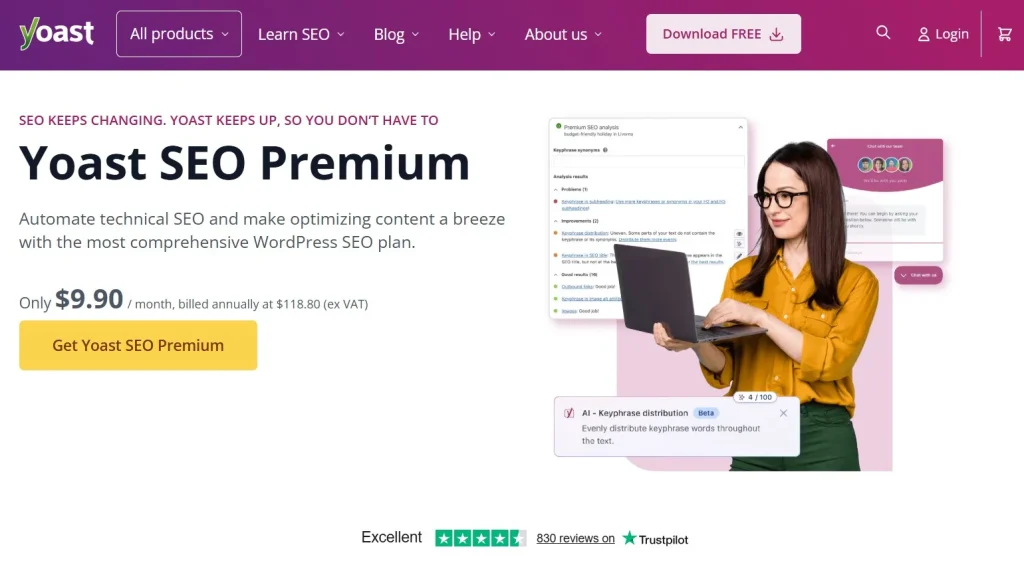
Beyond content analysis, Yoast handles several technical SEO tasks in the background, including XML sitemaps, canonical tags, structured data, breadcrumbs, robots settings, and selected crawl controls. That makes it useful for site owners who want to manage these settings without editing theme files or maintaining SEO code themselves.
2.1. Yoast SEO Free vs Premium
Yoast SEO Free covers the core SEO features most standard WordPress websites need. You can edit SEO titles and meta descriptions, generate XML sitemaps, manage canonical and indexing settings, use schema markup, and review basic SEO and readability signals.
For a personal blog, portfolio, small business website, or service site, these features may be enough for day-to-day SEO work.
Yoast SEO Premium adds tools aimed at larger or more active websites, including redirect management, internal linking suggestions, orphaned content checks, and multiple or related keyphrase analysis. It also includes AI-assisted features and premium support, although the exact AI functionality can vary by the current Premium offering.
These features become more useful when a site has a large content library or a publishing team that needs to manage SEO at scale.
The redirect manager is particularly useful when URLs change, helping site owners manage redirects without relying on manual server configuration. Internal linking suggestions, meanwhile, help editors find relevant older content to link from new pages.
| Capability | Yoast SEO Free | Yoast SEO Premium |
| SEO titles and meta descriptions | Included | Included |
| XML sitemaps | Included | Included |
| Canonical URLs | Included | Included |
| Schema markup | Basic controls | Expanded controls |
| Focus keyphrase analysis | One primary keyphrase | Multiple and related keyphrases |
| Redirect manager | Not included | Included |
| Internal linking suggestions | Not included | Included |
| Orphaned content checks | Not included | Included |
| AI-assisted tools | Limited or unavailable | Included features vary |
| Premium support | Not included | Included |
2.2. Main Features of Yoast SEO
Yoast brings several common WordPress SEO tasks into one interface. The main features include:
- Editing SEO titles and meta descriptions
- Generating XML sitemaps
- Managing canonical URLs
- Adding schema markup
- Configuring breadcrumbs
- Controlling indexing for selected content
- Reviewing SEO and readability signals
The traffic-light system is probably Yoast’s most recognizable feature. Red, orange, and green indicators give writers a quick overview of areas that may need attention while they edit.
The important point is not to chase a perfect green score. A green indicator does not guarantee rankings, and an orange result does not automatically mean a page needs to be rewritten.
The snippet editor lets you set the SEO title and meta description that you want search engines to consider for a page. Search engines can still rewrite these elements, but setting them yourself gives you more control over the page’s search appearance and messaging.
Yoast automatically updates XML sitemaps as you add or change content. It also handles canonical tags and schema markup in the background, reducing the amount of technical SEO work you need to manage manually.
These features are useful, but they are a toolkit rather than a complete SEO strategy. Yoast can help implement good practices, but it cannot determine whether a topic is worth targeting, whether an article satisfies search intent, or whether a website has enough authority to rank.
3. Yoast SEO Review
Yoast’s biggest strength is its straightforward workflow. The interface is easy to navigate, common SEO settings are close to the WordPress editor, and most standard tasks can be handled without technical configuration. The trade-off is that some advanced controls and workflow features are simplified or reserved for Premium.
| Area | Verdict |
| Ease of use | Beginner-friendly and easy to navigate |
| Content optimization | Useful for editorial checks, not a ranking predictor |
| Metadata | Simple and reliable |
| Technical SEO | Strong for standard WordPress sites |
| Compatibility | Works well with common WordPress tools |
| Performance | Generally manageable, depending on site configuration |
| Premium value | More useful for content-heavy websites |
3.1. Ease of Use
Yoast is straightforward to set up, and the default configuration is suitable for most standard WordPress sites. The interface is organized around the tasks users perform most often, so beginners can find SEO titles, meta descriptions, indexing settings, and content analysis without digging through complex menus.
The traffic-light system also makes the plugin approachable for new users. The downside is that it can encourage users to optimize for a score rather than for the reader. A green result should be treated as a helpful signal, not a requirement.
For content teams, this consistency is useful. Writers can follow the same basic SEO workflow without needing to understand every technical setting.
3.2. Real-World Editing Experience
Yoast works best as a final check before publishing. The SEO panel makes it easy to review titles, meta descriptions, internal links, and indexing settings without opening separate tools.
The readability checks are useful for spotting dense paragraphs, long sentences, and other issues that can make an article harder to scan. However, some keyword-related suggestions can feel restrictive in long-form content, especially when natural language and synonyms are more appropriate than repeating an exact phrase.
For that reason, Yoast is more useful as an editorial assistant than as a content scoring system. It can catch common issues, but the writer still needs to judge search intent, topic coverage, and overall quality.
3.3. Performance & Compatibility
For most standard WordPress sites, Yoast’s performance impact should be manageable, although the actual effect depends on hosting resources, database size, integrations, and the rest of the plugin stack.
Yoast works with the WordPress Block Editor and commonly used themes, page builders, WooCommerce, multilingual plugins, and caching tools. As with any major plugin, complex sites should be tested after updates rather than assuming every integration will behave identically.
One important compatibility consideration is to avoid running two full SEO plugins at the same time. Doing so can produce duplicate titles, canonical tags, schema, or sitemaps. When migrating to Yoast, move the existing SEO data, deactivate the previous SEO plugin, and check several important URLs after the switch.
3.4. Premium Value
Yoast SEO Free is enough for many standard WordPress websites. Premium becomes more useful when a site publishes frequently, manages a large content library, or needs workflow features such as redirects, internal linking suggestions, related keyphrase analysis, and orphaned content checks.
The main benefit of Premium is convenience and time savings rather than a direct ranking advantage. A small website with stable URLs may not need the additional tools, while publishers, agencies, and content teams are more likely to benefit from them.
For most users, the decision comes down to workflow rather than basic SEO functionality: Free covers the fundamentals, while Premium reduces the amount of manual work involved in managing a larger or more active site.
3.5. Pros and Cons
Pros
- Easy to install and use
- Reliable metadata and sitemap management
- Helpful readability checks
- Strong compatibility with common WordPress tools
- Useful free version
- Practical Premium workflow features
Cons
- Some advanced features require Premium
- Traffic-light scores can encourage over-optimization
- Less granular schema control than some alternatives
- No built-in rank tracking
- Premium licensing can become expensive for larger teams
4. Complete Your WordPress Stack with PluginPro
Yoast SEO handles search optimization, but it is only one part of a complete WordPress setup. Most websites also need tools for speed, security, backups, structured content, and visual design.
PluginPro brings many of these premium WordPress tools together in one library, giving website owners a simpler way to build and manage their WordPress stack. The following plugins can complement Yoast SEO in different areas of website management.
4.1 WP Rocket
Website speed is another important part of a complete WordPress stack. WP Rocket focuses on caching, file optimization, lazy loading, and other performance improvements that can support user experience and Core Web Vitals. Yoast handles search metadata and technical signals, while WP Rocket helps pages load more efficiently.
4.2 Advanced Custom Fields Pro
For websites with structured or custom content, ACF Pro provides a flexible way to organize additional fields for services, products, team profiles, directories, and similar content types. Yoast can then optimize the resulting pages for search. ACF Pro manages the content structure, while Yoast handles SEO settings for the resulting pages.
4.3 Elementor Pro
Elementor Pro focuses on the visual side of WordPress, allowing users to create landing pages, templates, service pages, and marketing layouts without coding. Yoast continues to manage metadata, indexing, and schema behind those pages. This combination suits users who want visual design controls without sacrificing access to standard SEO settings.
4.4 UpdraftPlus
Backups are another important part of maintaining a WordPress website. UpdraftPlus provides scheduled backups and restoration tools to help protect site content and data. This also matters for SEO because lost content, database problems, or failed updates can disrupt pages that have already built search visibility. Yoast improves how content is presented to search engines, while UpdraftPlus protects the underlying website.
4.5 Wordfence Security
Security also matters for SEO because compromised websites can expose visitors to malware, spam, or unauthorized content. Wordfence Security helps protect WordPress websites against common security threats, including malware, suspicious activity, and unauthorized access. While Wordfence Security serves a different purpose from Yoast SEO, the two plugins cover complementary areas of website management: Yoast focuses on SEO, while Wordfence Security helps protect the website and its content from security threats that could affect user trust and site stability.
A complete WordPress stack does not need every available plugin. The goal is to choose tools that solve specific needs without creating unnecessary overlap. PluginPro brings different categories of premium WordPress plugins and themes together in one library, making it easier to build a stack around your site’s requirements.
5. Frequently Asked Questions
1. Does Yoast SEO improve Google rankings automatically?
No. Yoast helps you optimize metadata, sitemaps, schema, canonical URLs, and content structure, but it cannot guarantee higher rankings. Results still depend on content quality, search intent, backlinks, website speed, and competition.
2. Is the free version of Yoast SEO enough?
Yes, for many small websites. It includes essential features such as SEO titles, meta descriptions, XML sitemaps, canonical URLs, schema markup, and readability checks. Premium is more useful for larger sites that need redirects and internal linking tools.
3. Is Yoast still the best SEO plugin for WordPress?
Yoast is still one of the best SEO plugins for WordPress, especially for beginners and content teams. However, Rank Math and All in One SEO may suit users who want more free features or advanced settings.
4. Can I switch from another SEO plugin to Yoast?
Yes. Yoast supports data migration from several popular SEO plugins. Back up your website first, import your SEO data, deactivate the old plugin, and check key pages for duplicate metadata or schema.
5. Is Yoast SEO Premium worth buying?
It can be worth it for websites that publish frequently, manage large content libraries, or need workflow features such as redirects and internal linking suggestions. For smaller sites with stable URLs, the free version may be enough. If you’re also looking for premium WordPress plugins and themes without purchasing each product separately, PluginPro offers a $4.5 per-item option and membership packages for users who need multiple products across their WordPress projects.
6. Conclusion
Yoast SEO remains a practical option for WordPress users who want a reliable and easy-to-manage SEO plugin. Its free version covers the essentials for many websites, while Premium adds useful workflow features for larger content libraries and more active publishing teams. However, Yoast is not the only option, and users who need more advanced controls or a broader free feature set may prefer another SEO plugin.
SEO is only one part of running a successful WordPress website. Performance, security, backups, content management, and design also play an important role in keeping a site fast, stable, and easy to manage. PluginPro brings premium WordPress plugins and themes together in one library, making it easier to build a complete toolkit around your website’s needs.
Ready to build your WordPress stack? Explore PluginPro to discover premium plugins and themes for SEO, performance, security, design, and more.